

The landscape of artificial intelligence is undergoing a fundamental transformation. For years, running complex models meant offloading tasks to massive cloud data centers. However, high operational costs, network latency, and growing privacy concerns have triggered a decisive shift toward edge ai. Modern consumer devices are now equipped with specialized silicon designed to handle high-throughput machine learning locally, ushering in an era of personal, secure, and instantaneous digital intelligence.
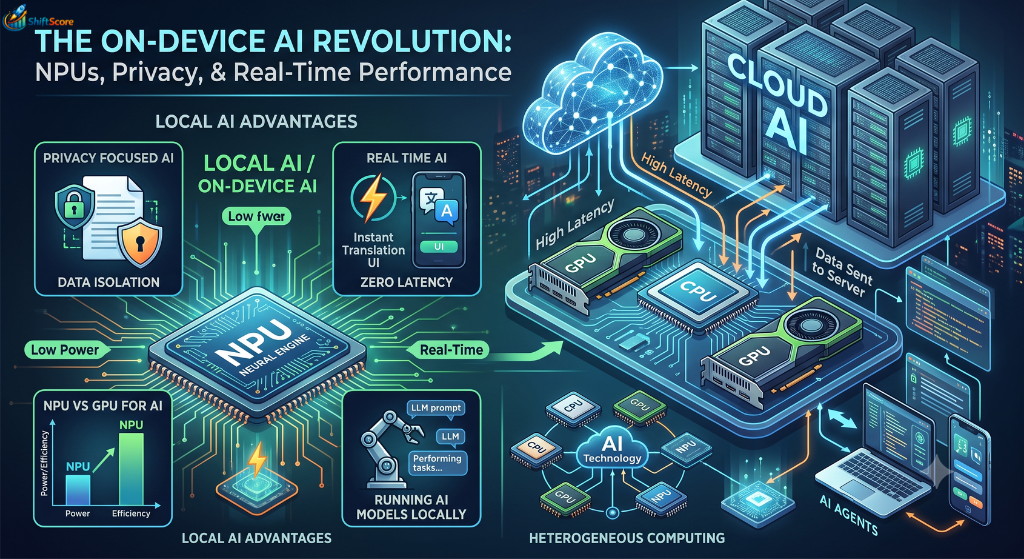
The Silicon Shift: Heterogeneous Computing and NPUs
Traditional chip architectures were never built for the continuous matrix math that drives generative ai. While CPUs manage sequential logic and GPUs excel at parallel rendering, running a local llm on a dedicated GPU can drain laptop batteries within hours.
To bridge this gap, modern chipmakers rely on heterogeneous computing—distributing workloads across the CPU, GPU, and dedicated neural silicon. The central driver of this architecture is the NPU (Neural Processing Unit), alongside specialized co-processors like Apple’s neural engine.
                   ┌───────────────────────────┐
│  Heterogeneous Computing  │
└─────────────┬─────────────┘
│
┌───────────────────────┼───────────────────────┐
▼                       ▼                       ▼
┌─────────────┐         ┌─────────────┐         ┌─────────────┐
│     CPU     │         │     GPU     │         │     NPU     │
│ Sequential  │         │ Parallel &  │         │ Continuous  │
│ System Ops  │         │ Heavy Batch │         │ AI Inference│
└─────────────┘         └─────────────┘         └─────────────┘
When comparing npu vs gpu for ai, energy efficiency is the deciding factor. While discrete GPUs deliver massive raw performance for model training, specialized npu chips execute real-time inference using a fraction of the power.
Key hardware metrics define this generational leap:
- NPU TOPS: Modern ai processors are rated by npu tops (Trillion Operations Per Second). Industry baselines now exceed 40 to 80 TOPS, allowing high-speed model execution without thermal throttling.
- Sustained NPU Performance: High npu performance ensures background tasks—such as live translation, audio processing, and continuous threat monitoring—run silently without hurting overall system speed.
Comparing Architectures: Edge AI vs Cloud AI
| Feature | Edge AI (Local) | Cloud AI (Remote) |
| Data Location | Stored on local disk | Sent to remote servers |
| Latency | Near-instantaneous | Network-dependent |
| Offline Support | Fully functional | Required active connection |
| Operating Cost | Zero token/subscription fee | Pay-per-token API fees |
| Power Target | Ultra-low wattage | High data center load |
When analyzing edge ai vs cloud ai or on device ai vs cloud ai, local processing offers distinct advantages: zero network reliance, immediate response times, and complete data isolation. While cloud ai remains essential for training massive frontier models, executing daily tasks through local ai is far more efficient.
Privacy, Speed, and Autonomy: The Local Advantage
1. Privacy-Focused, Uncompromised Security
Data leaks, corporate scraping, and cloud storage breaches make centralized AI risky for sensitive tasks. Embracing private ai guarantees that proprietary source code, personal financial records, and confidential communications remain strictly on local disk. With privacy focused ai, prompt data never traverses an external network.
2. Zero-Latency Execution
Real time ai applications demand instantaneous responses. Whether rendering local UI elements, transcribing live meetings, or powering gesture controls, executing running ai models locally removes the variable latency introduced by web requests and remote server queues.
3. Native Multimodal Capabilities
Modern local architectures excel at multimodal ai, simultaneously processing text, audio, image, and vision feeds directly on the device. An integrated NPU handles visual recognition and natural language processing simultaneously without dropping frame rates.
4. Autonomous Local AI Agents
The next leap in automation involves ai agents—autonomous programs designed to navigate local operating systems, organize local files, and run complex, multi-step productivity workflows. On device ai gives these agents direct, secure access to your desktop environment without exposing system controls to external cloud endpoints.
The Road Ahead for AI Technology
The evolution of ai technology is clear: intelligence is moving directly into silicon. As ai processors become standard across laptops, smartphones, and IoT hardware, developers are increasingly building applications optimized for local execution.
By combining the low-power precision of npu chips with the security of local llm architectures, the software industry is moving away from rent-based cloud compute and back toward user-owned hardware. The future of computing isn’t floating in a distant data center—it is running directly on your desk.





Leave a Reply