

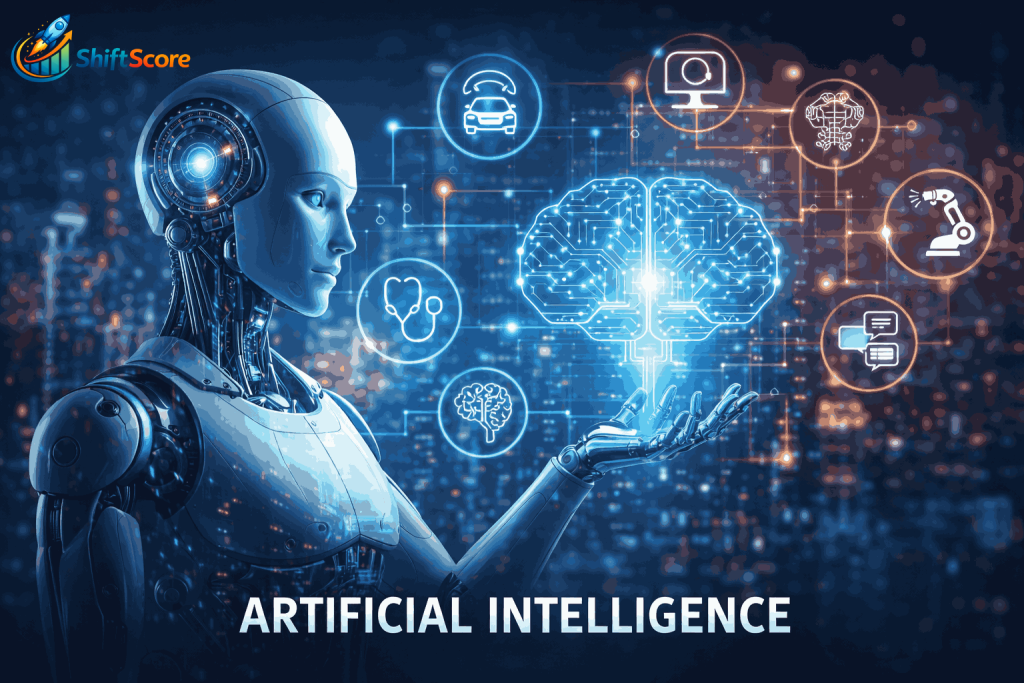
In 2026, artificial intelligence has become one of the most transformative forces in the digital world. From businesses to healthcare, education to entertainment, ai is reshaping how we live and work. The rapid growth of ai technology and the increasing use of ai tools are driving a new era of automation, intelligence, and efficiency. As the future of ai unfolds, organizations and individuals are embracing intelligent systems to stay competitive.
Understanding Artificial Intelligence
At its core, artificial intelligence refers to machines designed to simulate human intelligence. These systems rely on machine learning, deep learning, and neural networks to process data, recognize patterns, and make decisions.
Modern ai algorithms enable systems to learn from experience and improve over time. Technologies like reinforcement learning allow machines to adapt based on feedback, making them more efficient and accurate in real-world applications.
Rise of Generative AI and AI Tools
The emergence of generative ai has revolutionized content creation and problem-solving. Tools like ai image generator, ai voice generator, and ai code generator are empowering users to create visuals, audio, and software with minimal effort.
Businesses and creators are increasingly relying on ai tools and ai automation tools to streamline workflows. The popularity of ai chatbot systems has also grown, enabling companies to provide instant customer support and improve user experience.
AI Agents and Automation
One of the most exciting developments in ai technology is the rise of ai agents. These intelligent systems can perform tasks independently, making decisions based on data and predefined goals.
The integration of ai automation tools with ai agents is transforming industries by reducing manual work and increasing productivity. From managing workflows to handling customer interactions, ai is becoming an essential part of modern operations.
AI in Healthcare
The impact of ai in healthcare is profound. Advanced systems powered by artificial intelligence are improving diagnosis, treatment, and patient care.
Technologies like computer vision are used to analyze medical images, while machine learning models help predict diseases. The use of ai chatbot solutions in healthcare also enhances patient engagement and accessibility.
AI for Startups and Businesses
For entrepreneurs, ai for startups offers immense opportunities. Startups are leveraging ai tools to innovate, reduce costs, and scale operations quickly.
From marketing automation to product development, ai automation tools are enabling businesses to operate more efficiently. The use of ai code generator platforms is also accelerating software development, making it easier for startups to build applications.
Core Technologies Behind AI
The success of artificial intelligence depends on several key technologies. Neural networks form the foundation of modern AI systems, enabling machines to process complex data.
Deep learning enhances the capabilities of these systems, allowing them to perform tasks like speech recognition and image analysis. Meanwhile, reinforcement learning helps machines improve through trial and error, making them more adaptive.
These technologies, combined with advanced ai algorithms, are driving innovation across industries.
AI Technology and the Digital World
The integration of ai technology into everyday life is transforming the digital landscape. From smart assistants to recommendation systems, ai is making interactions more personalized and efficient.
The growth of generative ai and tools like ai image generator and ai voice generator is redefining creativity. Businesses are also using ai chatbot systems to enhance customer engagement and support.
Future of AI
The future of ai is filled with possibilities. As advancements continue, artificial intelligence will become even more integrated into daily life. The future of artificial intelligence includes smarter systems, improved automation, and new applications across industries.
With the rise of ai agents, ai automation tools, and advanced machine learning models, the next decade will see unprecedented growth in AI capabilities.
Challenges and Opportunities
While ai offers numerous benefits, it also presents challenges. Issues related to data privacy, ethics, and job displacement need to be addressed.
However, the opportunities outweigh the challenges. By leveraging ai tools and ai technology, businesses and individuals can unlock new levels of productivity and innovation.
Conclusion
In conclusion, artificial intelligence is transforming the world at an unprecedented pace. From ai in healthcare and ai for startups to innovations like generative ai, ai agents, and ai chatbot, the impact is vast and far-reaching.
The combination of machine learning, deep learning, neural networks, and reinforcement learning is driving the evolution of intelligent systems. As we move toward the future of artificial intelligence, embracing these technologies will be essential for growth and success.
The journey of ai technology has only just begun, and its potential to reshape industries and improve lives is limitless.







Leave a Reply