

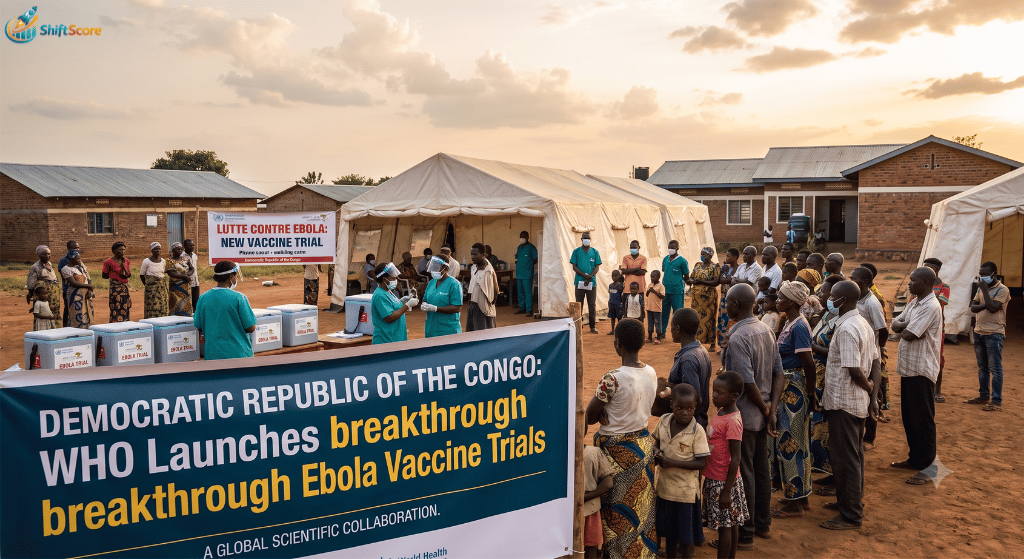
In a major milestone for global healthcare, the World Health Organization (WHO) and the Africa CDC have officially launched human clinical trials for a new ebola vaccine. As containment efforts intensify across Central Africa, this medical breakthrough marks a decisive turning point in tackling the ebola outbreak 2026.
With international attention focused on the region, stay tuned as we break down what this means for science, safety, and epidemic prevention.
Understanding the 2026 Crisis
The current virus outbreak, centered primarily in the Democratic Republic of the Congo, involves the less-common Bundibugyo strain of ebola virus disease. Unlike the more common Zaire strain, there was previously no widely approved targeted shot or therapeutic available for this specific variant.
Preventing rapid virus transmission in remote and high-risk communities has posed complex challenges for emergency responders. High population mobility, dense forested terrain, and infrastructure gaps have turned containment into a critical public health emergency. Without targeted immunization, healthcare workers have had to rely almost exclusively on isolation protocols, contact tracing, and supportive medical care to curb the spread.
Breakthrough in Vaccine Innovation
To address this ongoing crisis, scientists have accelerated medical research to deliver a specialized ebola vaccine. According to the latest WHO ebola update, clinical trials are now actively enrolling participants to test candidate doses designed specifically against the Bundibugyo virus.
This rollout represents a triumph of modern vaccine innovation. By leveraging advanced viral vector platforms, researchers developed candidates in record time while adhering to strict clinical protocols. The initiative operates under the broader WHO vaccine program, which prioritizes candidate formulas for dangerous pathogens that lack existing commercial treatments.
Emergency diagnostic kits specific to the strain have also been deployed alongside the candidate doses, allowing medical personnel to identify infections and initiate protective protocols faster than ever before.
Prioritizing Rigorous Vaccine Safety
Whenever a candidate shot moves rapidly through clinical pipelines, ensuring high standards of vaccine safety remains paramount. Health regulators and independent review boards are closely monitoring trial participants to track immune responses and evaluate side effects in real time.
Transparency remains a central pillar of the deployment effort. As reported in the latest WHO latest news briefings, joint teams from the WHO and regional health authorities are engaging directly with local communities to explain how the trial works, address hesitancy, and build mutual trust. Community leaders and local health advocates are working on the ground to ensure clear communication regarding both trial safety and voluntary participation.
The Path Forward for Global Healthcare
The ongoing response to the ebola outbreak 2026 demonstrates how rapid coordination between international bodies and local health infrastructure can save lives. Through close collaboration between the World Health Organization, local ministries, and the Africa CDC, field teams are building a scalable blueprint for future outbreaks.
As candidate evaluations continue over the coming months, this deployment of a new ebola vaccine stands as a testament to what global scientific cooperation can achieve. By advancing vaccine safety, expediting field deployment, and strengthening surveillance networks, the global community is taking vital steps toward ending this public health emergency and protecting vulnerable populations from future threats.







Leave a Reply