

Artificial Intelligence has transformed the modern world, but its journey began with simple systems known as reactive machines. These systems represent the earliest stage of basic artificial intelligence and continue to play an important role in understanding how AI evolved. For anyone exploring ai for beginners, learning about reactive machines is the perfect starting point.
This blog provides a clear introduction to artificial intelligence through the lens of reactive machines, making it ideal for learners and those taking ai courses for beginners.
introduction to artificial intelligence
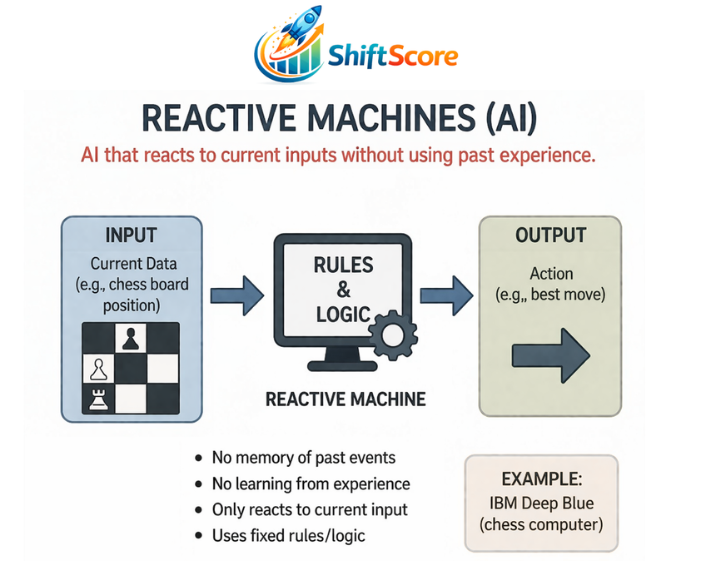
Reactive machines are the most fundamental type of AI systems. They operate based on current inputs and do not store past experiences. This makes them the simplest form of basic artificial intelligence.
In any introduction to artificial intelligence, reactive machines are described as systems that respond to specific situations without learning from previous data. They analyze inputs and produce outputs instantly, making them efficient but limited.
For those starting with ai for beginners, reactive machines help in understanding how machines can mimic decision-making without true intelligence or memory.
basic artificial intelligence
Reactive machines function using predefined rules. They observe the environment, process input, and generate output without relying on historical data. This makes them a core example in basic artificial intelligence studies.
In most ai courses for beginners, reactive systems are explained using simple input-output models. These systems follow a fixed logic, making them predictable and reliable for certain tasks.
For example, a chess-playing AI like IBM’s Deep Blue (classic system) could analyze the current board and make decisions without remembering past games. This is often highlighted in any introduction to artificial intelligence as a key milestone.
Understanding this concept is crucial for anyone learning ai for beginners, as it lays the groundwork for more advanced AI systems.
Key Features of Reactive Machines
Reactive machines have distinct characteristics that define their role in basic artificial intelligence:
- No memory of past experiences
- Operate only on present data
- Follow predefined rules
- Fast and efficient decision-making
These features are commonly covered in ai courses for beginners and form an essential part of any introduction to artificial intelligence.
For learners exploring ai for beginners, these features help differentiate reactive machines from more advanced AI types.
Examples of Reactive Machines
Reactive machines are widely used in simple applications. Some common examples include:
- Chess-playing systems
- Basic recommendation engines
- Rule-based chatbots
- Automated response systems
These examples are frequently discussed in ai courses for beginners to illustrate how basic artificial intelligence works in real-world scenarios.
For those seeking an introduction to artificial intelligence, these examples make it easier to understand how reactive systems function without learning capabilities.
Advantages of Reactive Machines
Despite their simplicity, reactive machines offer several benefits:
1. Speed and Efficiency
Reactive systems process information quickly, making them ideal for real-time applications. This is why they are often included in ai for beginners learning modules.
2. Simplicity
They are easy to design and implement, which makes them a key topic in basic artificial intelligence education.
3. Reliability
Since they follow predefined rules, their behavior is predictable. This makes them useful in controlled environments, as explained in many ai courses for beginners.
These advantages make reactive machines an essential part of any introduction to artificial intelligence.
Limitations of Reactive Machines
While reactive machines are important, they also have limitations:
1. No Learning Capability
They cannot improve over time because they do not store past data. This limitation is a major focus in ai for beginners studies.
2. Lack of Adaptability
Reactive systems cannot handle unexpected situations effectively. This is often highlighted in basic artificial intelligence discussions.
3. Limited Intelligence
They cannot perform complex reasoning or decision-making, which is why advanced AI systems are needed.
Understanding these limitations is crucial for anyone taking ai courses for beginners or exploring an introduction to artificial intelligence.
Reactive Machines vs Modern AI
Modern AI systems, such as machine learning and deep learning models, go beyond reactive machines by learning from data. However, reactive machines remain the foundation of basic artificial intelligence.
In ai for beginners, this comparison helps learners understand the evolution of AI. Reactive systems represent the starting point, while advanced systems build upon this foundation.
Most ai courses for beginners include this comparison to provide a complete introduction to artificial intelligence.
Importance of Reactive Machines in AI Learning
Reactive machines are not just historical concepts—they are essential for understanding AI fundamentals. For anyone starting with ai for beginners, they provide a clear and simple entry point.
In fact, many ai courses for beginners begin with reactive systems before moving on to more complex topics. This structured approach ensures a strong foundation in basic artificial intelligence.
A solid introduction to artificial intelligence always includes reactive machines because they explain how machines can make decisions without learning.
Future Relevance of Reactive Machines
Even in 2026, reactive machines remain relevant. They are used in systems where simplicity, speed, and reliability are more important than learning capabilities.
For example, automated control systems and basic decision engines still rely on principles of basic artificial intelligence. This makes them an important topic in ai for beginners education.
As technology evolves, reactive machines will continue to serve as the building blocks for more advanced AI systems, reinforcing their importance in any introduction to artificial intelligence.
Conclusion
Reactive machines are the foundation of artificial intelligence and a crucial concept for anyone starting their AI journey. They represent the simplest form of basic artificial intelligence, focusing on immediate responses rather than learning or adaptation.
For learners exploring ai for beginners, understanding reactive machines provides clarity on how AI systems work at a fundamental level. They are also a key topic in ai courses for beginners, offering a practical and accessible entry point into the world of AI.
This introduction to artificial intelligence shows that even the simplest systems can have a significant impact. By mastering the basics of reactive machines, you can build a strong foundation for exploring advanced AI technologies in the future.










Leave a Reply