

The enterprise AI landscape is changing rapidly as businesses move beyond experimentation and begin deploying artificial intelligence across everyday operations. A major development in this transformation is the partnership between TCS and Anthropic, bringing advanced Claude AI capabilities into large-scale enterprise environments.
The collaboration highlights how generative AI, large language models, and intelligent automation are becoming essential components of modern business strategies. By combining TCS’s enterprise expertise with Anthropic’s AI technology, the partnership aims to help organizations adopt AI more effectively and responsibly.
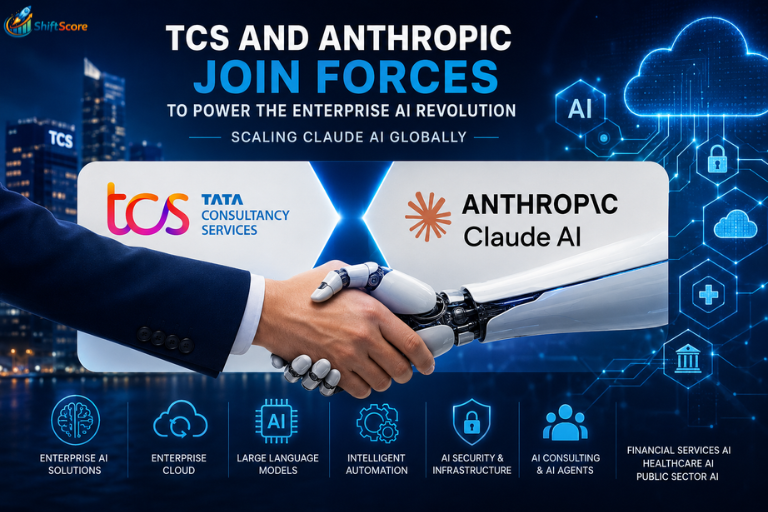
TCS and Anthropic Expand Enterprise AI
The TCS Anthropic partnership represents a significant step in the global expansion of enterprise AI. TCS brings decades of experience in technology consulting, digital transformation, and industry-specific solutions, while Anthropic is known for developing Claude, an AI platform designed with a strong focus on reliability and safety.
Through this collaboration, businesses can explore Claude AI for tasks such as software development, research, document analysis, customer support, knowledge management, and workflow automation.
The partnership also strengthens TCS’s portfolio of AI solutions, helping companies integrate AI software into existing technology environments rather than treating artificial intelligence as a standalone tool.
Claude AI Meets Intelligent Automation
One of the biggest opportunities created by the TCS partners with Anthropic initiative is the combination of Claude AI with intelligent automation.
Traditional automation generally follows predefined rules. Modern generative AI can understand natural language, summarize information, generate content, analyze documents, and assist employees with complex tasks.
When these capabilities are combined, organizations can create more flexible AI-powered workflows. For example, employees could use Claude AI to analyze large collections of business documents, generate reports, assist with coding, or retrieve information from internal knowledge systems.
This makes enterprise AI particularly valuable for organizations managing large amounts of information and complex processes.
Financial Services AI Could See Major Benefits
The financial sector is one of the industries where financial services AI could have a significant impact. Banks, insurance companies, and financial institutions handle enormous volumes of documents, transactions, customer interactions, and regulatory requirements.
With appropriate controls, Claude AI and other large language models can support research, compliance documentation, customer service, software engineering, and internal knowledge management.
However, financial institutions also require strong AI security, governance, and privacy controls. This is where responsible AI becomes critical.
Organizations cannot simply deploy an AI model and expect it to operate independently. They need systems that monitor outputs, protect sensitive information, and maintain appropriate human oversight.
Healthcare AI and Public Sector AI
The partnership could also support industries where accuracy, security, and responsible deployment are particularly important.
Healthcare AI has the potential to assist organizations with administrative workflows, medical documentation, research support, and information management. At the same time, healthcare organizations must carefully protect sensitive patient information and comply with applicable regulations.
Similarly, public sector AI could help government organizations improve document processing, citizen services, knowledge management, and operational efficiency.
These applications demonstrate why responsible AI is becoming increasingly important. Enterprise organizations need AI systems that are not only powerful but also secure, transparent, and appropriately governed.
Enterprise Cloud and AI Infrastructure
Large-scale AI deployment requires more than an advanced model. Companies also need reliable enterprise cloud, computing resources, data systems, and AI infrastructure.
As organizations integrate Claude AI into business workflows, cloud platforms and enterprise technology environments will play a central role.
Modern AI infrastructure must support scalability, security, data integration, and performance. Businesses also need appropriate controls around access to AI models and corporate information.
This growing infrastructure requirement is creating opportunities for technology providers, cloud companies, and AI consulting firms.
AI Agents and the Next Enterprise Wave
The next major stage of enterprise AI could involve AI agents capable of completing multi-step tasks with limited human intervention.
Instead of simply answering questions, AI agents can potentially coordinate workflows, retrieve information, interact with software systems, and complete repetitive business processes.
The combination of AI agents, Claude AI, intelligent automation, and enterprise applications could significantly change how employees work.
For TCS, this creates an opportunity to help customers move from individual AI experiments toward organization-wide AI transformation.
Responsible AI Will Be Essential
Despite the excitement surrounding artificial intelligence, enterprise adoption comes with significant challenges. Companies must consider data privacy, cybersecurity, regulatory compliance, model accuracy, intellectual property, and human oversight.
That makes responsible AI a fundamental requirement rather than an optional feature.
The TCS Anthropic partnership could help organizations approach AI adoption with a combination of technology, consulting expertise, and governance practices. Successful enterprise deployment will depend not only on the power of an AI model but also on how effectively businesses integrate it into their existing operations.
The Future of Enterprise AI
The partnership between TCS and Anthropic reflects a broader shift in the technology industry. Businesses are increasingly looking beyond AI experimentation and focusing on measurable productivity, automation, and business transformation.
From financial services AI and healthcare AI to public sector AI, the potential applications are expanding rapidly. At the same time, demand for AI consulting, AI security, AI infrastructure, and enterprise cloud is expected to grow as organizations scale their AI programs.
With Claude AI, generative AI, large language models, and AI agents becoming increasingly integrated into enterprise technology, the future of business could be significantly more automated and intelligent.
The TCS Anthropic partnership is therefore more than a collaboration between two technology companies. It represents another important step toward a world where enterprise AI becomes deeply embedded in the way organizations operate, innovate, and serve customers.






Leave a Reply