

The global artificial intelligence industry is entering a new era as the world’s biggest technology companies dramatically increase their investments in AI infrastructure. In 2026, Microsoft, Amazon, Alphabet, and Meta are collectively spending hundreds of billions of dollars to expand AI data centers, develop advanced AI chips, improve AI software, and build next-generation cloud computing platforms. This record-breaking AI investment highlights how the competition for leadership in AI technology has become one of the most important business stories of the year.
Industry leaders believe the future of artificial intelligence depends on powerful computing resources, scalable infrastructure, and innovative AI models. As demand for AI-powered applications continues to grow, Big Tech companies are accelerating their long-term strategies to dominate the evolving AI industry.
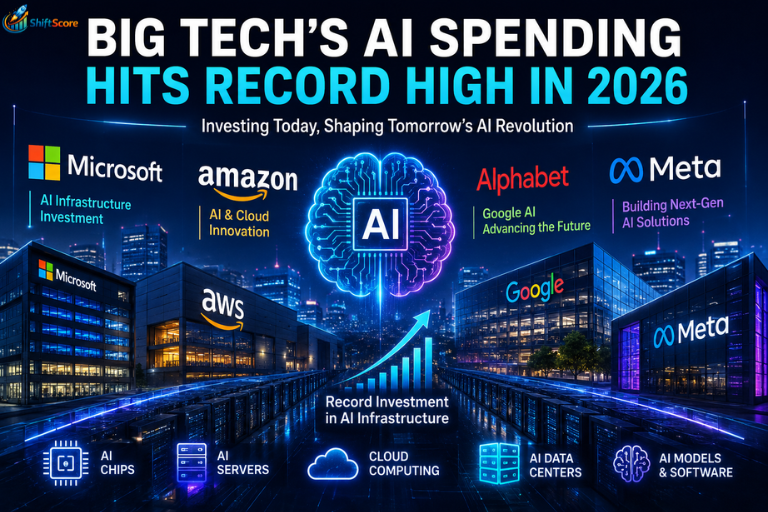
Why Big Tech Is Spending More on AI
The rapid adoption of generative AI has transformed business priorities across the technology sector. Companies are investing heavily in AI infrastructure because modern AI models require enormous computing power and advanced networking capabilities.
Microsoft continues expanding its partnership with OpenAI, integrating AI across Windows, Microsoft 365, Azure, and enterprise services. CEO Satya Nadella has repeatedly emphasized that AI will reshape productivity, software development, and business operations for years to come.
At the same time, Amazon is strengthening Amazon AI services through Amazon Web Services AI, enabling businesses to build and deploy AI applications more efficiently. CEO Andy Jassy believes AI represents one of the biggest technological transformations since the rise of cloud computing.
AI Infrastructure Becomes the New Battleground
Today’s AI competition extends far beyond software. Companies are investing in AI servers, networking equipment, storage systems, and massive AI data centers capable of training increasingly sophisticated AI models.
Alphabet continues expanding Google AI capabilities while improving Google Cloud’s AI offerings. CEO Sundar Pichai has highlighted AI as the company’s most significant technological opportunity, with new AI features appearing across Search, Workspace, and Android.
Meanwhile, Meta is rapidly scaling Meta AI products while investing in open AI research and next-generation infrastructure. CEO Mark Zuckerberg has committed billions of dollars to AI research, computing capacity, and intelligent assistants that support billions of users worldwide.
NVIDIA Powers the AI Revolution
No discussion about the AI boom is complete without NVIDIA. The company’s advanced AI chips have become essential for training and running modern AI models. As organizations build larger AI data centers, demand for NVIDIA AI hardware continues to rise across industries.
CEO Jensen Huang has positioned NVIDIA at the center of the global AI ecosystem by delivering high-performance GPUs that power research labs, startups, cloud providers, and enterprise AI deployments. These processors have become critical components of today’s AI infrastructure, enabling faster model training and large-scale AI applications.
Cloud Computing Drives Enterprise AI
The future of enterprise AI depends heavily on cloud computing platforms. Organizations increasingly rely on cloud providers to access scalable AI resources without building expensive infrastructure themselves.
Microsoft Azure, Amazon Web Services AI, and Google Cloud now offer businesses advanced AI platforms for model training, automation, analytics, and application development. These cloud services reduce costs while accelerating innovation across healthcare, finance, education, manufacturing, and retail.
The growing adoption of AI in enterprise environments is creating new opportunities for software developers, startups, and businesses seeking to improve efficiency through intelligent automation.
AI Innovation Continues to Accelerate
The pace of AI innovation has increased significantly during 2026. Companies are releasing smarter AI assistants, advanced reasoning systems, multimodal AI models, and industry-specific AI software designed to solve complex business challenges.
At the same time, OpenAI, Microsoft, Alphabet, Meta, and Amazon continue introducing new capabilities that improve productivity, customer support, software engineering, and content creation. Their ongoing AI investment demonstrates confidence that artificial intelligence will remain a major driver of future economic growth.
Challenges Facing the AI Industry
Despite rapid progress, the AI industry faces several important challenges. Building modern AI data centers requires enormous amounts of electricity, advanced cooling systems, and reliable semiconductor supply chains. Governments and regulators are also increasing attention on AI safety, privacy, transparency, and responsible deployment.
Companies must balance rapid innovation with sustainable infrastructure while ensuring AI systems remain secure, reliable, and beneficial for users worldwide.
Conclusion
The record-breaking AI investment made by Microsoft, Amazon, Alphabet, Meta, NVIDIA, and OpenAI signals that the global AI race is only beginning. Investments in AI chips, AI servers, AI infrastructure, AI software, and cloud computing are reshaping the technology landscape at an unprecedented pace.
With leaders such as Satya Nadella, Andy Jassy, Sundar Pichai, Mark Zuckerberg, and Jensen Huang driving innovation, the future of artificial intelligence looks increasingly transformative. As organizations continue adopting AI solutions, 2026 is likely to be remembered as the year Big Tech accelerated the next phase of the global AI revolution.






Leave a Reply